


March 17, 2026
By Anjali Kochhar
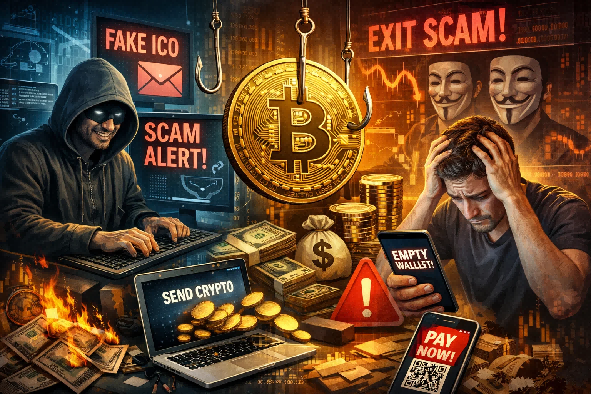
The rapid growth of digital assets has opened new investment opportunities, but it has also created fertile ground for crypto scams, with fraudsters increasingly targeting new and inexperienced investors. Cybersecurity experts say the number and sophistication of cryptocurrency scams have grown significantly in recent years, making awareness and security practices more important than ever.
Industry data shows that cryptocurrency fraud has become one of the fastest-growing forms of online financial crime. According to blockchain analytics firm Chainalysis, scammers stole an estimated $17 billion worth of cryptocurrency in 2025, with fraudulent investment platforms, phishing attacks, and social-engineering schemes accounting for a large portion of these losses.
Experts say many scams exploit the excitement around quick profits in the crypto market while taking advantage of the technical complexity of blockchain systems.
Fake Crypto Investment Platforms
One of the most common crypto scams involves fake cryptocurrency trading platforms designed to mimic legitimate exchanges. Victims are typically approached through social media advertisements, messaging apps or online communities and are promised unusually high returns from crypto trading.
Once victims deposit funds, the platform often displays fake profits to gain their trust and encourage them to invest more money. However, when investors attempt to withdraw their funds, withdrawals are blocked, or victims are asked to pay additional “fees” before accessing their money. Eventually, the website disappears along with the invested funds.
Experts warn that any platform promising guaranteed or unusually high returns should be treated as a major red flag.
Phishing and Wallet Credential Theft
Another widespread form of fraud is phishing, where attackers send emails, text messages or links that redirect users to counterfeit websites resembling legitimate crypto exchanges or wallet providers.
When victims enter their login credentials or private keys, attackers gain immediate access to their accounts and transfer funds to other wallets.
Cybersecurity researchers warn that phishing attacks are particularly dangerous in the crypto sector because blockchain transactions are irreversible, making it extremely difficult to recover stolen funds once they are transferred.
AI-Driven Impersonation Scams
Fraudsters are also increasingly using artificial intelligence and deepfake technology to create convincing impersonation scams. These scams often involve videos or voice recordings that appear to feature well-known entrepreneurs, influencers, or industry leaders promoting fake investment schemes.
Cybersecurity reports show that scammers frequently misuse the identities of famous personalities such as Elon Musk or Donald Trump in fake cryptocurrency giveaway promotions circulating on social media.
These scams typically claim that users can double their cryptocurrency by sending funds to a specific wallet address. Once the transfer is made, however, the scammers disappear and the funds are never returned.
Romance and Social Engineering Scams
Authorities worldwide have also reported an increase in romance-based crypto scams, sometimes called “pig-butchering” schemes.
In such cases, fraudsters build trust with victims through social media or dating platforms over weeks or months. After establishing a relationship, they introduce a supposedly profitable cryptocurrency investment opportunity and persuade victims to deposit funds into fraudulent trading platforms.
Victims are shown manipulated dashboards displaying significant profits, encouraging them to invest larger amounts before the scammers eventually vanish with the funds.
Investigators say these scams are often run by organized criminal groups operating across multiple countries.
How Investors Can Avoid Crypto Scams
Experts say the best defense against crypto fraud is awareness and strong security practices.
Investors are advised to carefully verify the legitimacy of any crypto platform before transferring funds. Legitimate exchanges and services typically provide transparent information about their operations, leadership teams and regulatory status.
Users should also avoid clicking on suspicious links received through unsolicited emails or messages and instead access platforms directly through official websites.
Another critical security measure is maintaining control over private keys and wallet security.
Mr. Sathvik Vishwanath, Co-Founder & CEO, Unocoin, said selecting the right crypto wallet is a key step in protecting digital assets.
“Choosing the right crypto wallet today goes beyond simply finding a place to store digital assets it is about ensuring long-term security, accessibility, and control.”
He emphasized that strong security features should always be a priority.
“Security should always be the primary consideration. Users should look for wallets that provide strong protection features such as private key ownership, multi-factor authentication, and reliable backup options.”
Maintaining direct control over private keys helps users remain the true custodians of their digital assets.
“A wallet that gives users full control over their keys ensures that their assets remain in their own custody rather than relying entirely on third parties.”
Experts also highlight that usability and transparency are equally important when choosing a crypto wallet.
“Equally important is the user experience. A good wallet should be simple and intuitive, allowing users to easily send, receive, and track their assets without unnecessary complexity.”
With many investors now holding multiple tokens across different blockchain networks, compatibility has become another key factor.
“As the crypto landscape expands, compatibility with multiple tokens and blockchain networks is also becoming increasingly valuable for investors who hold diversified portfolios.”
Security specialists also advise users to download wallet applications only from official sources and ensure that updates are regularly installed.
“Transparency and reputation also matter significantly. Users should opt for wallets that have a strong track record, active development, and a community that trusts the platform.”
Developers who release regular updates and communicate openly about security improvements demonstrate stronger commitment to protecting users.
“Regular security updates and clear communication from developers indicate a wallet that prioritizes user protection.”
Conclusion
Crypto scams continue to evolve as fraudsters adopt new technologies and social-engineering tactics to target investors. Experts say the key to staying safe lies in vigilance, verification, and responsible handling of digital assets.
Understanding common scam techniques, verifying platforms before investing, and using secure wallets with strong authentication can significantly reduce the chances of falling victim to fraud.
