


March 25, 2026
By Xuanyan Hou, Lingzhen Liu, Wu Yang, Yunfei Liu, Hong Kong Baptist University Journalism Students

Web3 Digital Payments Face Mounting Security Risks
The rapid advancement of digital payments and asset transactions in the Web3 era has exposed significant security vulnerabilities. Flaws in technical architectures, evolving cyber attacks, and delayed regulatory responses are intertwining to impede industry progress, according to experts at a recent summit in Hong Kong, as regulators prepare to roll out stablecoin licenses and broader digital asset rules in 2026.
Michael Tam, head of the Trustworthy Research Department at Bank of East Asia, highlighted a stark disconnect between technological innovations and regulatory understanding in digital asset protection. Technologies like hardware security modules (HSMs) and blockchain offer strong safeguards, but regulators’ lack of clear frameworks has made banks hesitant to engage, hindering the conversion of these tools into compliance assurances.
Tony Tan, the co-founder and CEO of cybersecurity firm Imperium, revealed dire losses: global digital asset thefts have surpassed 37 billion dollars since 2012, with approximately 3.4 billion dollars stolen in 2025 alone, per Chainalysis reports. Most incidents target Web3 exchanges, where fund tracing remains challenging. Traditional anti-money laundering tools provide only retrospective analysis, lacking real-time detection. Hackers are increasingly using AI to replicate user behaviors, tones, and audio-video for social engineering, easily bypassing single-channel verifications and heightening asset risks.Mark Ng, head of Zending Digital Assets, noted substantial gaps in integrating Web3 with traditional finance. Absent unified standards create security holes during system adaptations, and stablecoin fragmentation complicates uniform management across chains and issuers. Barry Chan, chief digital officer and head of FINNOSpace, and others emphasized custody architecture deficiencies: without blending centralized and decentralized technology, key management risks single-point failures that are prime targets for hackers, while cross-system interoperability adds vulnerabilities due to inconsistent security protocols.

Overall, Web3 security has shifted from isolated technical flaws to multifaceted issues spanning infrastructure, regulation and human behavior, constraining large-scale industry growth just as new regulated products are coming to market in Hong Kong and abroad.
Comparative Analysis of Global Regulatory Landscapes
The global cryptocurrency regulatory environment offers key lessons for Hong Kong as it finalizes stablecoin and tokenization regimes. Timing is critical: jurisdictions that implement clear policies early gain a competitive edge, regardless of the specifics. The European Commission formally proposed MiCA on September 24, 2020, while Dubai enacted Law No. 4 of 2022 on February 28, 2022, establishing VARA. Both jurisdictions built frameworks ahead of major market demand, drawing significant capital inflows.
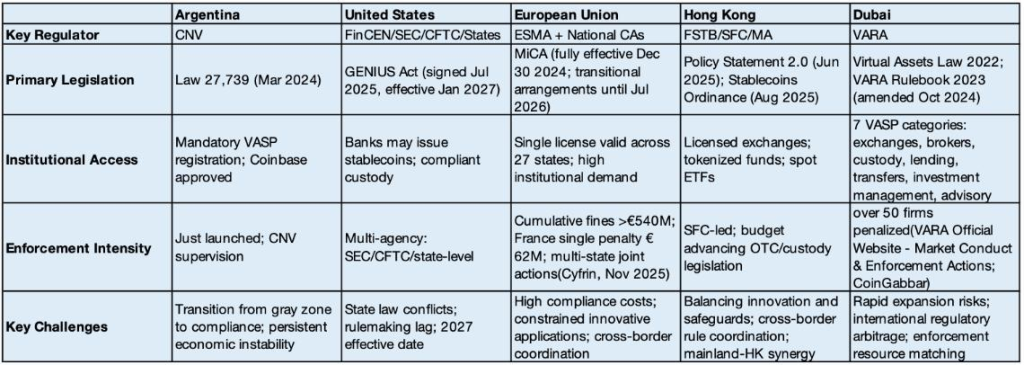
Stablecoins have emerged as a focal point in monetary sovereignty debates. The United States is seeking to reinforce dollar dominance through legislation such as the GENIUS Act; the European Union is advancing a digital euro; Hong Kong is integrating offshore RMB, stablecoins and tokenized finance within a ring-fenced framework; and Dubai emphasizes trading volumes and virtual asset licensing. Effective enforcement enhances competitiveness, with regions that offer streamlined entry alongside transparent oversight attracting institutional investors. Being “crypto-friendly” now signifies regulatory clarity and reliability rather than permissiveness.
Protecting the security of Web3 wallets mainly lies in maintaining control over the underlying assets. From the institutional perspective, multi-institutional joint signatures are currently the mainstream solution: through multi-person authorization to complete operations, firms can reduce the risk of a single point of failure.
Robert Rogenmoser, CEO of Securosys SA, said that if complex authorization procedures were adopted for small transactions as well, it would seriously hinder business operations. Therefore, a hierarchical risk control system can balance both efficiency and security. “Small transactions are automatically reviewed. For large transactions, such as those exceeding US$100,000 (HK$781,630), not only multiple signatures are required for authorization, but also manual verification will be triggered. In some cases, the system may even contact the customer to confirm the authenticity of the transaction. This effectively prevents operational risks caused by internal personnel,” he added.
Thomas Kung, CISO of Coinhako, said security issues caused by operational errors in encryption institutions are common in the industry. “For example, a couple of days ago, an incident occurred at a certain exchange in South Korea. The staff intended to transfer 2,000 units of a certain cryptocurrency, but mistakenly selected the wrong currency, resulting in the mistransfer of a large amount of assets and ultimately causing significant losses,” he added.
The clues of suspicious transactions mainly come from two channels: early warnings from automated transaction monitoring systems, and abnormalities discovered through manual investigation. The core of the investigation is to first lock the entire transaction trace, and clarify the source of the funds, the flow path, and the final destination.
Francis Choi, head of financial crime compliance at BOC Life Crime Unit, said that when exchanges suffer asset losses, it is often because they lack a comprehensive transaction verification mechanism across the entire chain. “For ordinary retail investors, a transaction of 2,000 cryptocurrencies is already considered an abnormal transaction. The system should have triggered an alert in such cases. However, for institutional transactions, such amounts of transactions are quite common. Therefore, it is necessary to specifically establish risk control rules that take into account the characteristics of different trading entities,” she added.
These examples underscore why regulators in Hong Kong, Europe, the United States and the Middle East are converging on requirements around stronger custody, transaction monitoring and incident reporting as digital asset markets scale in 2026.
Prospects for the Development of Web3 Network Security
As Web3 scales, cybersecurity must shift from reactive fixes to proactive, risk-based frameworks. Decentralization introduces new attack surfaces — such as smart contract vulnerabilities and DeFi scams — that demand prevention and continuous monitoring. AI enhances early detection and adaptive defense, though attackers also weaponize it, fueling an ongoing arms race.
AI-enabled controls can strengthen custody and workflows through dynamic identity and access management and risk-based approvals, reducing static failure points. These systems, however, require rigorous threat modeling to avoid introducing new vulnerabilities of their own. People remain a primary risk; phishing and operational errors persist even in sophisticated institutions. Effective programs therefore pair secure technical design with measures such as transaction allowlists and anomaly monitoring to flag suspect activity before on-chain finality locks in losses.
Net-net, layered technical controls, AI-informed defenses and adaptable regulation can achieve meaningful risk reduction in Web3, though residual risk will always endure. Sustained progress depends on continuous collaboration between industry and regulators — a theme that is increasingly visible in Hong Kong’s 2026 policy push on stablecoins, tokenization and virtual asset platforms.
About the Editor
Joe Pan teaches Asia’s first Master of Journalism course on “Covering Cryptocurrency and Blockchain” at Hong Kong Baptist University. He is a contributing editor at Blockwind News. An early adopter of blockchain technology, he has covered major crypto conferences globally since 2019 and moderated Web3 events across Asia.
