


March 24 2026
By Zhang Yiwen, Zhao Yilin, Zhu Lingjie , Fang Luyao, Hong Kong Baptist University Journalism Students
HONG KONG — With the Hong Kong Monetary Authority (HKMA) poised to issue its first stablecoin licenses in March, and the inaugural batch expected in mid-March after China’s annual “Two Sessions,” the city is placing a historic bet that digital assets must solve real-world economic problems. Earlier this year, Beijing dropped a sweeping ban prohibiting any issuance of RMB-pegged stablecoins overseas, setting a “firewall” that is forcing global issuers to rethink their Asia strategies in real time.
China’s first major move came on February 6, when Beijing launched a landmark joint directive explicitly prohibiting any issuance of RMB‑pegged stablecoins overseas without prior approval, with the People’s Bank of China and other central agencies warning that yuan‑linked tokens threaten monetary sovereignty and could be used to evade capital controls. In early March, regulators followed up with a clarifying statement that sought to cool market expectations ahead of Hong Kong’s first stablecoin licenses, stressing that the February ban on offshore RMB stablecoins and tight scrutiny of tokenized real‑world assets remained fully in force and should not be read as a green light for broader crypto experimentation. While the February notice drew a hard red line around yuan‑linked products, the March messaging focused on managing hype and reiterating that any Hong Kong regime must operate as a narrowly defined “pilot zone” that does not weaken China’s existing crypto and capital‑control framework.
The License Race: Hong Kong’s Utility Bet
At Consensus Hong Kong, Hong Kong Chief Executive John Lee delivered a video message confirming that “the first batch of stablecoin licenses will be issued in early March,” reaffirming the city’s ambition to become “a global hub for digital asset innovation.” Subsequent local reporting has narrowed that window, indicating that the first licenses are expected to be issued in mid-March after the conclusion of the “Two Sessions,” with fewer than four firms likely to be approved initially as regulators move cautiously under Beijing’s gaze.
Speaking to a packed audience at the Hong Kong Convention and Exhibition Centre, Financial Secretary Paul Chan laid out the government’s vision. “We see Web3, blockchain technology, and AI as powerful enablers of the real economy,” he said. “Our policy focus is on how these technologies can enhance efficiency, lower costs, and support concrete real-world use cases.”
Behind the scenes, the license race is narrowing. Industry sources indicate that among the 36 applications received, three sandbox participants have emerged as frontrunners: Anchorpoint Financial Limited — a joint venture between Standard Chartered Hong Kong, Animoca Brands, and HKT; JINGDONG Coinlink Technology; and RD InnoTech, the entity behind the proposed HKDR stablecoin. According to a report by the Hong Kong-based financial media outlet Hong Kong Economic Times on March 11, the first stablecoin licenses are expected to be issued in mid-March after the conclusion of the “Two Sessions,” the annual meetings of China’s National People’s Congress and the Chinese People’s Political Consultative Conference. The number of licenses in this initial batch is expected to be fewer than four.
Li Qiang, senior researcher at Hashkey Group, said that as regulations take effect, unlicensed firms will either fade out or become distribution partners for license holders. “Competition will shift from scale expansion to ecosystem breadth and compliance costs.”
Beyond Speculation: What Utility Actually Looks Like
“The core purpose of people using stablecoins now is to solve real business problems that traditional finance cannot address,” said Mark Homeier, Chief Business Development Officer at Interlace, a financial platform that adopts stablecoin through Visa card integrations.
“If I need to transfer $200 to a partner in a certain country but cannot do so through traditional channels, stablecoins fill that gap. No speculation, just utility.”
The tokenization of real-world assets (RWA) represents another frontier. Jessica Cao, APAC CEO of Huma Finance, described a green energy DeFi protocol where users deposit stablecoins and earn 8% yields with no minimum threshold. “This model helps project parties access capital globally and fundamentally changes how people participate in investment,” she explained. “It’s not about trading volatile assets anymore. It’s about yield-bearing tools tied to real infrastructure.”However, Yuanjie Zhang, Co-Founder of Conflux, pointed out that the on-the-ground reality in Hong Kong remains messy: local OTC crypto conversion shops have lost their direct USDT-to-HKD exchange channels due to policy adjustments. “Users are now forced to use Ethereum as an intermediary medium, exposing them to asset loss from price volatility,” he explained. Licensed HKD stablecoins with sufficient liquidity and adoption could fill this gap.
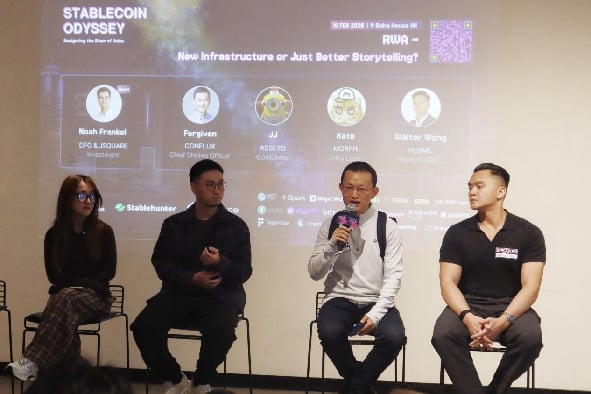
Yuanjie Zhang also warned about “risks compliance alone cannot eliminate,” such as de-pegging and asset freezing. “80% of Tether’s assets are in US Treasuries, creating deep entanglement with US regulators, which introduces political considerations and creates potential risks for stablecoin holders.”
The Mainland “Firewall”
This is where Beijing’s February 6 notice re-enters the picture, not as abstract policy, but as a concrete constraint reshaping business models. The joint regulatory notice — widely interpreted as formalizing a ban on offshore issuance of yuan stablecoins and imposing strict limits on tokenization of real-world assets — effectively draws a red line around RMB-linked products, even as Hong Kong moves forward with HKD- and possibly USD-pegged coins.
Allen Ding, head of Bitfire Research, states that the notice creates a distinct “offshore firewall” system with Chinese characteristics. “Hong Kong’s licensing regime is a ‘pilot zone’ designed to test HKD stablecoins in cross-border payments,” Ding explained. “The mainland ban is a ‘firewall’ preventing offshore RMB stablecoins from becoming a black hole for circumventing capital controls.”
For international issuers, the message is clear. “Any attempt to issue RMB-pegged stablecoins without Beijing’s permission will face significant legal risks,” Ding said. This means international players will shift their focus to HKD stablecoins instead. In practice, that shift has already begun, with issuers shelving or scaling back RMB concepts and instead tailoring products to fit Hong Kong’s ring-fenced regime and China’s insistence on maintaining tight control over the yuan.
Three Defining Trends
As the three-day conference drew to a close, a consensus emerged around what comes after licensing. Brian Mehler, CEO of Stable, emphasized Hong Kong’s historical strength as a banking center. “Asia is very much primed to have a basket of tokens enabling seamless on-chain swaps,” he said. “Reciprocity between different frameworks will speed up adoption.”Allen Ding of BitFire offered a more granular prediction: the battleground has shifted from issuance to distribution. “Stablecoin-as-a-Service is becoming the dominant model in 2026, the real thresholds are licenses, banking relationships, and risk control systems.”
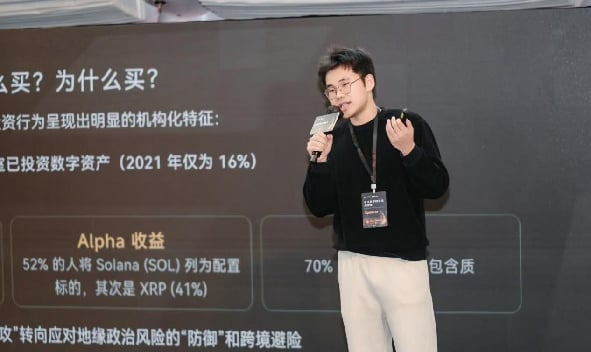
Ding pointed to three defining trends. First, regulators globally are treating stablecoins as electronic payment instruments rather than crypto assets, as seen in both the EU’s MiCA framework and proposed U.S. legislation. Second, reserve assets are shifting toward short-term Treasuries or central bank deposits, following the $150 billion in stablecoin reserves now parked in U.S. government debt. Third, a multi-currency landscape is emerging as the dollar’s dominance faces challenges, with Hong Kong dollar stablecoins positioning themselves for Asian trade corridors.
“The competition now is about scenario integration,” Ding added. “Whoever gets stablecoins into verticals, from payment apps to corporate treasuries, wins.”
About the Editor
Joe Pan teaches Asia’s first Master of Journalism course on “Covering Cryptocurrency and Blockchain” at Hong Kong Baptist University. He is a contributing editor at Blockwind News. An early adopter of blockchain technology, he has covered major crypto conferences globally since 2019 and moderated Web3 events across Asia.
