



January 08, 2026
By Our Correspondent
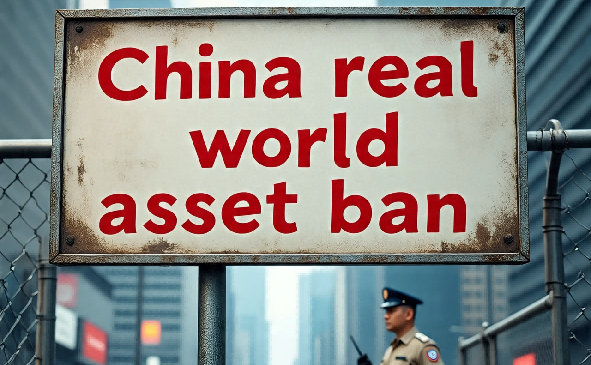
China’s financial establishment has moved decisively to shut down one of the crypto industry’s newest fashions. Seven of the country’s most influential financial-sector associations have jointly declared real-world asset (RWA) tokenisation an illegal financial activity, stripping it of any claim to regulatory ambiguity or experimental status.
In a rare show of coordinated force, seven bodies representing internet finance, banking, securities, asset management, futures, listed companies and payment clearing warned that RWA schemes have no legal basis under Chinese law. Rather than treating them as innovations awaiting supervision, the notice categorised them alongside stablecoins, cryptocurrencies and crypto mining as manifestations of illicit virtual-currency activity—high-risk ventures prone to fraud and speculation.
Such cross-industry statements are unusual and, as Liu Honglin, a lawyer cited in local media, observed, typically surface only at moments of heightened concern about systemic financial risk. The message this time was unambiguous: RWA tokenisation is not a grey area, but a prohibited one.
The notice defined RWA tokenisation broadly as financing or trading conducted through tokens or token-like claims on assets or debt. Regulators highlighted multiple dangers, including fictitious assets, business failure and rampant speculation. They also closed off a common defence used by crypto projects, stressing that no RWA tokenisation activities have been approved by Chinese regulators—there is no pilot phase, registration pathway or regulatory sandbox to appeal to.
This stance places China firmly at odds with jurisdictions such as Singapore, which has emerged as a global hub for RWA experimentation. Chinese authorities instead pointed to clear violations of existing law. Issuing tokens to the public to raise funds may constitute illegal fundraising; facilitating token trading without authorisation can amount to an unlawful public securities offering; and leveraged or bet-like token trading may fall under illegal futures operations. These interpretations draw directly on China’s Criminal Law and Securities Law.
Even when projects claim technological transparency or asset backing, regulators argue that tokenisation cannot guarantee legal ownership or enforceable liquidation rights over underlying assets. Risk spillovers, they add, remain uncontrollable even in ostensibly compliant structures.
The crackdown extends beyond mainland borders. Domestic brokerages have reportedly been urged to halt RWA tokenisation activities in Hong Kong, and attempts to skirt the rules via “overseas compliance”, “real-world asset anchoring” or “technology services” narratives were explicitly called out. The notice applies not only to project operators but to the entire Web3 ecosystem supporting them.
Of particular significance is the adoption of a “knew or should have known” standard of liability. Under this approach, mainland staff of offshore crypto or RWA service providers—and domestic firms or individuals who provide services to them—can be held accountable without proof of intent. Infrastructure providers, technology contractors, marketers, influencers and payment firms may all face legal consequences if they support RWA projects targeting Chinese users. Even offshore entities could be exposed if a single operations employee is based in China.
The practical effect, analysts suggest, is to dismantle the domestic Web3 service chain linked to RWA tokenisation: once core activities are banned, secondary services lose their economic rationale.
Authorities justified the move by pointing to a rise in scams masquerading as RWA projects, using stablecoins, so-called worthless coins and tokenised assets to conduct illegal fundraising, pyramid schemes and speculative trading. The timing is also telling. China is simultaneously pushing to internationalise its digital yuan, including through a new blockchain-focused operations centre in Shanghai, while barring private giants such as Ant Group and JD.com from issuing stablecoins in Hong Kong.
The message is consistent with Beijing’s broader approach to finance: innovation is welcome only so long as it does not challenge the state’s control over money—or invite risks it cannot fully contain.
