



January 21, 2026
By Joe Pan
The annual “New Year, New Me” spirit has taken a rather brutal turn in the digital asset world, where a flurry of layoffs suggests that the crypto industry is less interested in self-improvement resolutions and more focused on simple survival tactics.
Following a turbulent close to 2025 marked by market volatility, major crypto firms from Asia to the US are slashing staff in the new year. This trend underscores a significant strategic shift: a move away from aggressive expansion toward sustainable, lean, and heavily regulated business models.
MANTRA Announces Restructuring After Token Crash
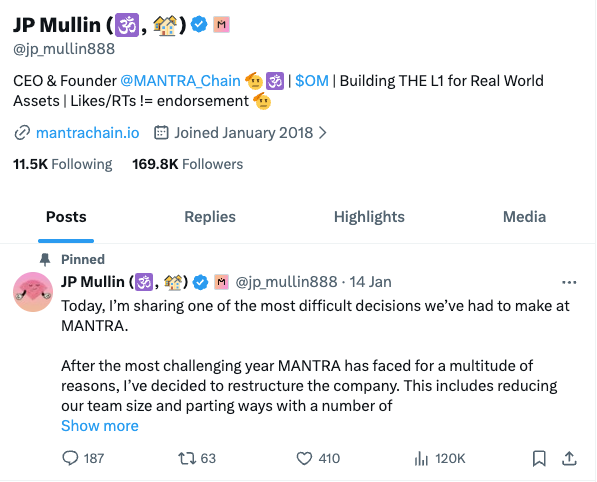
MANTRA, a real-world-asset-focused layer-1 blockchain, announced a company-wide restructuring with significant staff cuts after a brutal 2025 for its token, confirming the move in public statements by CEO John Patrick Mullin on Jan. 14, 2026.
MANTRA’s restructuring was triggered by what CEO John Patrick Mullin described as “extremely unfortunate and unfair events of April 2025,” a prolonged market downturn and rising competitive pressure that left the company’s cost base “unsustainable.” The cuts hit teams across business development, marketing and HR, with Mullin publicly accepting full responsibility for the decisions and apologizing to departing staff and their families in an internal note later shared with the community.
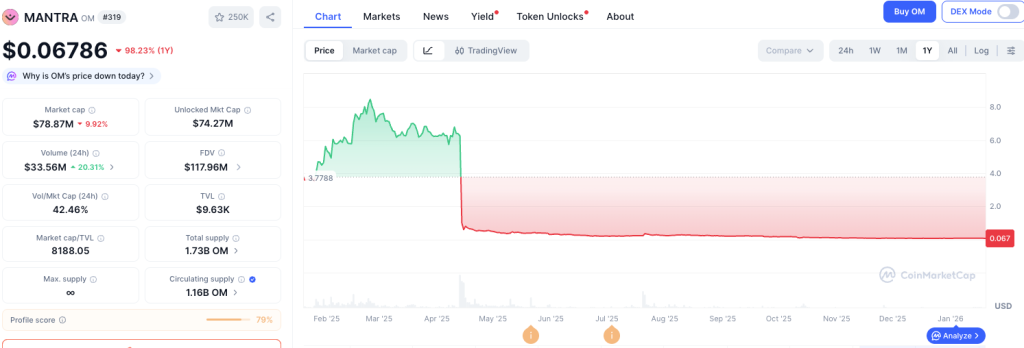
The crisis traces back to spring 2025, when MANTRA’s OM token suddenly plunged by about 90%, from roughly 6.3 dollars to below 0.5 dollars, wiping out an estimated 5.5 billion dollars in market capitalization and prompting community suspicions of fraud. Mullin initially attributed the crash to large‑scale liquidations of positions that had used OM as collateral, but a subsequent analysis by on‑chain research group OddEyeResearch alleged that insiders controlling more than 90% of the token’s supply had manipulated the market, deepening the loss of confidence around the project.
Hedera Foundation’s Strategic Pivot Under New Leadership
The Hedera Foundation, a major player in the enterprise blockchain space, confirmed in early January 2026 that it underwent “organizational changes” that included global staff reductions. This follows the appointment of new CEO Charles Adkins on January 1, 2025, who was tasked with leading a new “chapter” focused on DeFi, AI, and sustainability. According to sources close to the Hedera Foundation, the global headcount has drastically reduced from over 50 employees to the low teens, with almost the entire APAC team eliminated.
Reddit communities—often a bellwether for ground-level sentiment—have voiced mixed reactions to Adkins’ strategy. While some expressed initial optimism, calling Adkins a “gem,” others noted persistent “sell pressure” on the network’s native HBAR token throughout 2025, leading to a year-long low by December 2025. The Governing Council’s subsequent decision in late 2025 to tighten the foundation’s grant funding, capping it at 3.5 billion HBAR, essentially forced Adkins to streamline operations to match the new “performance-based spending” mandate. Insiders indicate the cuts are part of a painful, but necessary, transition away from the original, high-spending HBAR Foundation model.
OKX and Polygon Lead Layoffs in Asia
The trend is global and pervasive. In Asia, cryptocurrency exchange OKX has significantly reduced its institutional and international workforce as part of a global restructuring as reported by us earlier. Sources suggest that approximately one-third to half of the institutional sales team has exited the company, though OKX has not provided official figures . The Singapore-based company is pivoting towards a more traditional client-coverage model amidst growing pressure for stricter regulatory compliance.
Similarly, Polygon Labs, a prominent Ethereum scaling solution, saw a substantial workforce reduction in January 2026. Earlier reports indicate that around 30% of staff were dismissed. This coincided with a significant investment of over $250 million to acquire payments providers, signaling a pivot toward building a vertically integrated, regulated stablecoin payments platform.
Polygon has since disputed media reports that it cut roughly 30% of its workforce, framing the reduction instead as a targeted adjustment following recent acquisitions that produced overlapping roles. Public disclosures and follow‑up reporting suggest the impact was closer to about 60 positions following a new $250 million acquisition, implying a significantly smaller share of total headcount than the widely cited 30% figure.
Market Reaction: “Efficiency” Trumps “Expansion”
Historically, massive layoffs in the tech sector have sometimes been met with stock gains as investors reward efficiency and cost-cutting measures. In the crypto market, the reaction has been nuanced but broadly positive, suggesting that investors are prioritizing a lean, focused strategy over aggressive, high-burn expansion.
- Hedera (HBAR): The HBAR token entered January 2026 in a quiet, sideways trend. Technical indicators suggested stabilization rather than panic selling. Despite the news of cuts, analysts were setting bullish targets for HBAR prices in late January, as the market seemed to view the restructuring as a move towards a “cleaner structure” that reduces long-term downside risk.
- OKX (OKB): The OKB token price has been volatile but generally stable, trading in the range of $110-$115 following the January 13 news. Price action was more influenced by a massive token burn in August 2025 than current layoffs.
- Polygon (POL/MATIC): Polygon’s POL token initially dipped by roughly 15% after the January 16 restructuring announcement, but it held key support levels. The dip was largely attributed to short-term profit-taking rather than a fundamental breakdown, with the price action supported by the underlying news of a strategic pivot to regulated payments.
Hong Kong, however, appears to be an exception to this global trend, with some even calling it a bright spot in the crypto jobs market. Specifically, Hong Kong-based exchanges Hashkey and OSL seem to be on a hiring spree and actively adding headcount. This is based on job listings found on their company websites and is confirmed by sources inside the companies. Their expansion suggests a localized strategic confidence, counter to the widespread global restructuring.
As CEOs across the tech landscape prioritize efficiency over expansion, many seem to view layoffs as a badge of honor in an AI-driven economy. Perhaps the only thing growing faster than AI adoption this year are the ranks of the newly unemployed.
About the Author
Joe Pan is an editor and producer at Blockwind News. An early adopter of blockchain technology, he has covered major crypto conferences globally since 2019 and moderated Web3 events across Asia. Joe is part of the founding team of Blockwind News and teaches Asia’s first Master of Journalism course on “Covering Cryptocurrency and Blockchain” at Hong Kong Baptist University.
